June 2025 - Earlier this month, 70 southern white rhino were translocated from South Africa to Akagera National Park in Rwanda. This landmark move highlights Akagera as a key conservation area for Africa and reinforces Rwanda’s important role in global rhino conservation efforts
Following the introduction of 30 rhino to Akagera in 2021, which has since grown to 41, the park has proven to be a secure and suitable habitat for the species. This makes Akagera well-positioned to receive the additional 70 rhino which will play a vital role in establishing meta-populations across the continent. In turn this enhances the species’ natural ecological function and contributes to overall biodiversity health, while opening the door for future range expansion into other safe, well-managed protected areas.
This translocation of 70 white rhino marks the first cross-continental move for the Rhino Rewild Initiative, and the first rhino move by air of this scale, thanks to funding from The Howard G. Buffett Foundation, and the partnership and collaboration of the Rwanda Development Board, the Munywana Conservancy, and conservation and translocation experts. This translocation was completed in two phases, each comprising 35 rhino, spaced three days apart.
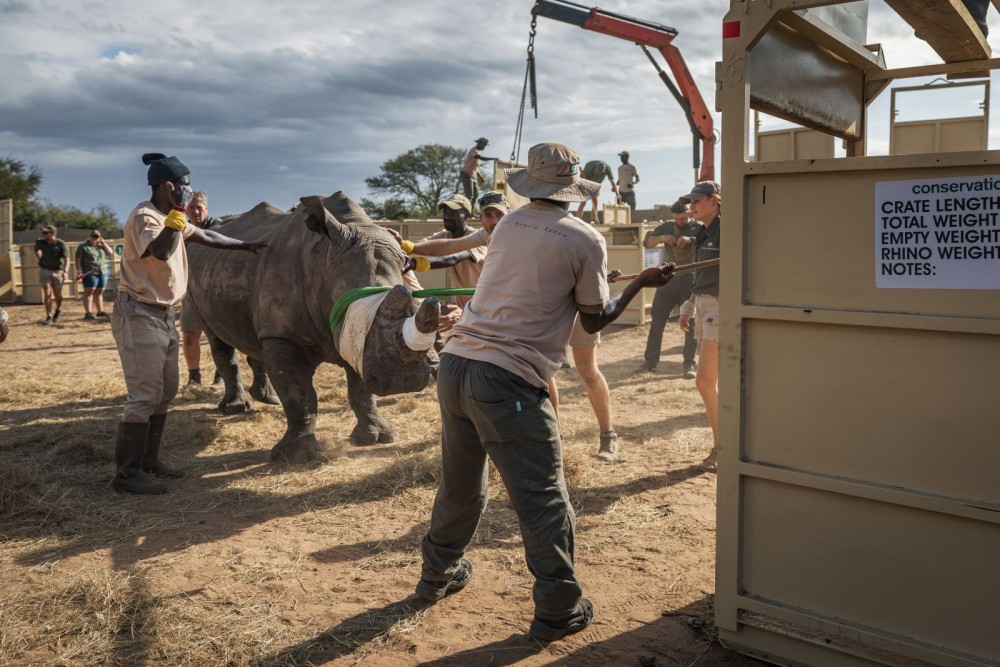
Following months of extensive planning and working with various experts in the field, the rhino were initially moved within South Africa from the Rhino Rewild site to the Munywana Conservancy to improve their ability to adapt to their new home. The Munywana Conservancy is a collaboration of community and private landowners, including the Makhasa Community Trust, the Mnqobokazi Community Trust, andBeyond Phinda and ZUKA Private Game Reserves. This preliminary stage of rewilding exposed the rhino to naturally occurring diseases such as Trypanosomiasis and climatic conditions similar to Akagera. The final phase of the 3,400 km journey involved the rhino being transported by truck in individual steel crates from Munywana to King Shaka International Airport in Durban. They were then carefully loaded by cranes into a Boeing 747, flown to Kigali International Airport, and finally transported to Akagera National Park by road. The entire journey from the Munywana Conservancy to the Park took approximately two days for each of the two groups of rhino, with continuous monitoring of their well-being by veterinary teams. After a two-day journey for each group, the rhino have been released into the park. Over the coming several weeks, their health and behaviour will be closely monitored by a dedicated veterinary team to manage any stress associated with the move and to ensure each rhino adapts well to its new environment.
Progressing the Rhino Rewild Initiative
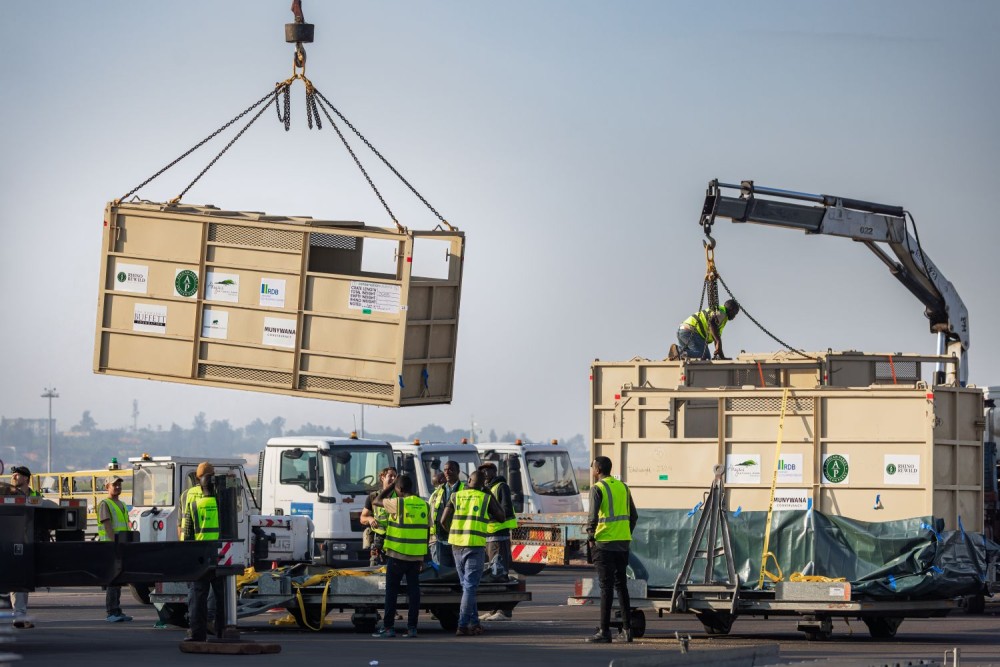
This is the first cross-continental translocation since the launch of the Rhino Rewild Initiative. Each translocation is a step towards ensuring the establishment of several viable populations of southern white rhino on the continent, thereby de-risking the future of the species and playing an important role in restoring ecosystems.
Since May 2024, a total of 376 rhino have been moved from the Rhino Rewild project site. Of these, 216 rhino were rewilded to six protected areas across South Africa, while 160 were placed in a staging reserve, to build immunity to parasitic diseases ahead of their release into protected areas across the continent – 70 of which have since been moved to Akagera National Park.
A Year of Rhino Translocations
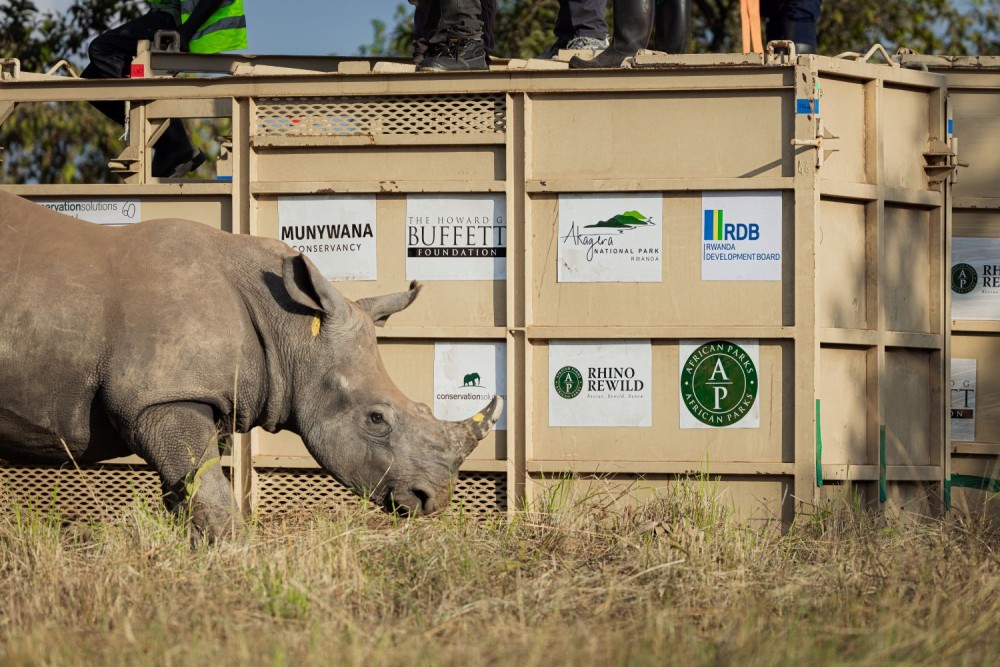
Of the six South African destinations, one site reintroduced rhino after a period of local extinction, while the others bolstered existing populations to enhance genetic diversity and long-term viability. These sites include the Munywana Conservancy in KwaZulu-Natal – a collaboration of community and private landowners that include the Makhasa Community Trust, the Mnqobokazi Community Trust and andBeyond Phinda and ZUKA Private Game Reserves; the member reserves of the Greater Kruger Environmental Protection Foundation (GKEPF) in Mpumalanga and Limpopo, which received 120 rhino to reinforce an existing, well-protected population; and Dinokeng Game Reserve in Gauteng, a 19,000-hectare conservation area managed through a unique partnership of 180 landowners and the Gauteng Provincial Government.
Rewilding 2,000 rhino is a monumental undertaking. It requires time, partnerships and expertise, tireless coordination – and significant funding. The success of these moves is thanks to The Howard G. Buffett Foundation, and the founder funders of Rhino Rewild, The Rob Walton Foundation and Pershing Square Foundation, for their valuable strategic partnership, the commitment of governments and communities, and ongoing support from conservation authorities and expert teams.