About the Authour
Evan Trotzuk
Through one of the largest dugong satellite-tagging studies ever undertaken in East Africa, researchers in Bazaruto Archipelago National Park are gaining new insight into how dugongs use this coastline and what long-term conservation may require.
Off the coast of Mozambique, a chain of slender islands encloses one of the Indian Ocean's most remarkable seascapes. The Bazaruto Archipelago shelters a wide, shallow bay whose waters shift colour with the sun and tides, with the pale jade over shallow, sandy flats deepening to cobalt as the seafloor slides away to deep-water channels. Beneath the surface, vast meadows of seagrass carpet the seafloor, sustaining an ecosystem that includes one of the ocean's most quietly extraordinary animals: the dugong.
Dugongs, sometimes called sea cows, are large, slow-moving marine mammals that graze on seagrass much as cattle graze on grass. They have roamed the world's tropical seas for millions of years. Today, they are in trouble. Once widespread along the coastlines of the Indian and Pacific Oceans, they have all but disappeared from the western limit of their range, East Africa. Our work has revealed that the waters around Bazaruto are now home to the last known viable population on the entire East African coast, which is numbered at only a few hundred animals, largely protected within Bazaruto Archipelago National Park (BANP).
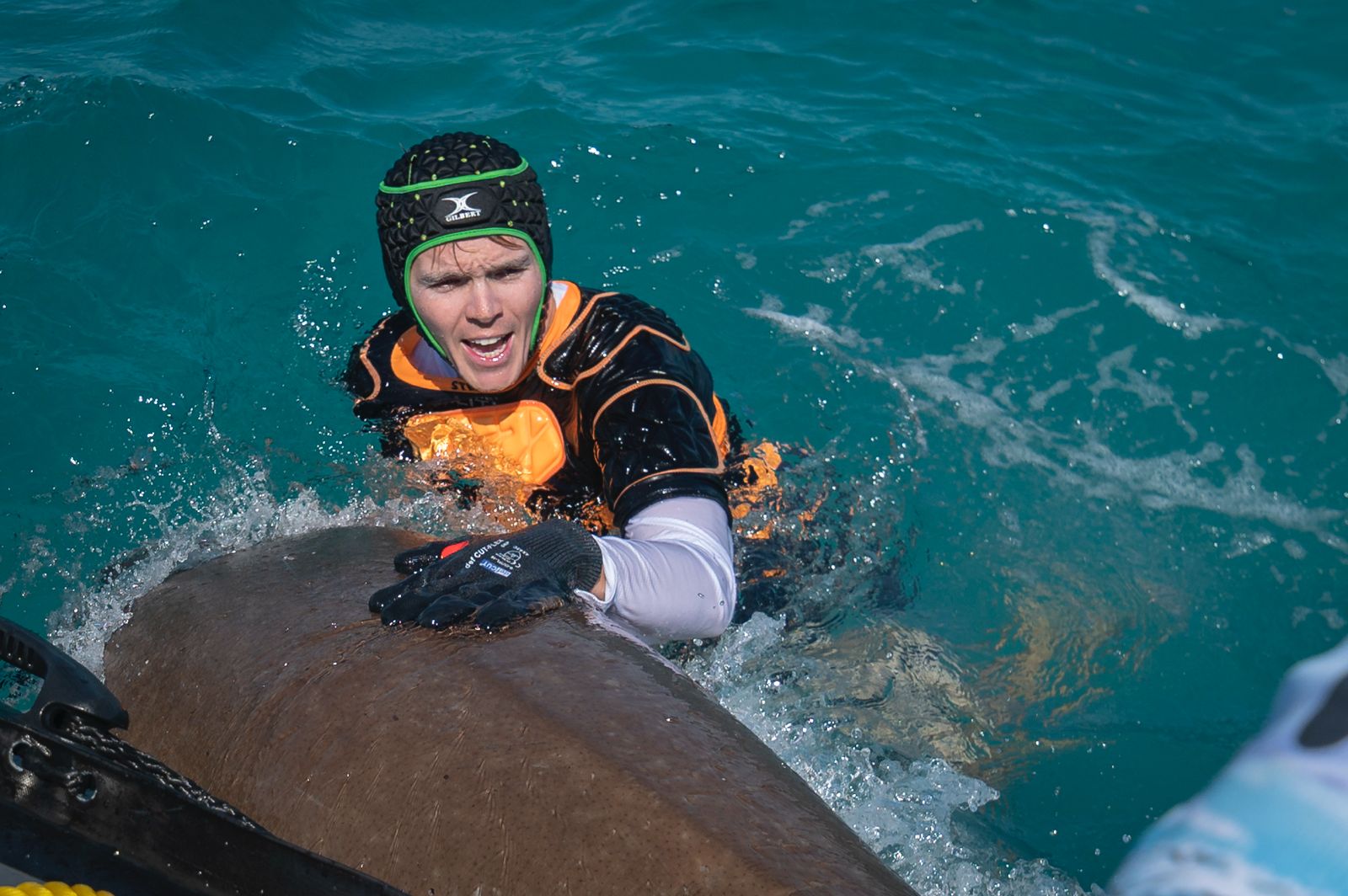
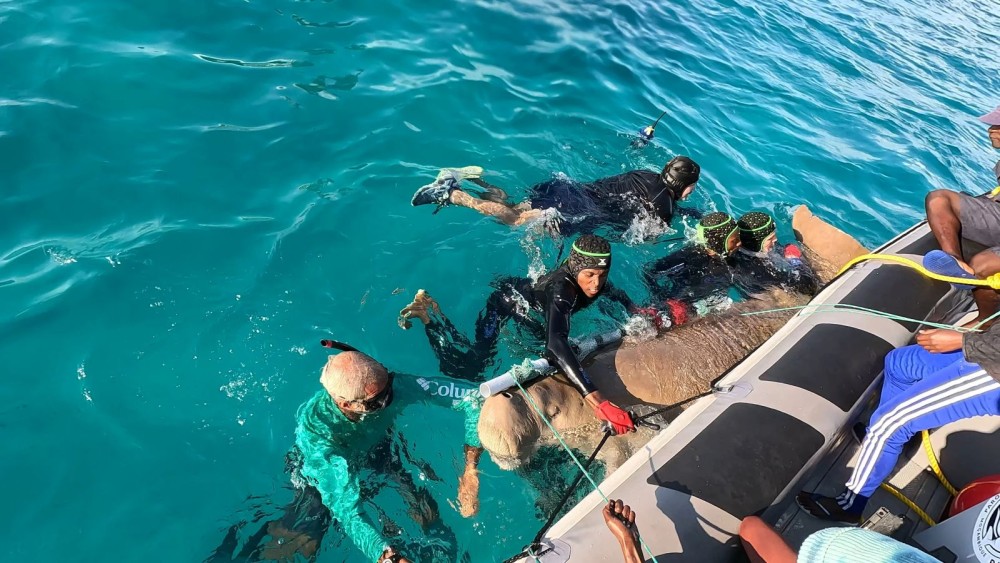
Understanding how these animals move and what they need to survive has never been more urgent. Over the course of three field seasons, our team set out into the Bazaruto seascape and did something that has never been done in East Africa on this scale: we attached satellite tags to 49 dugongs. Each tag transmitted the animal's location continuously, giving us a detailed, real-time picture of where it went, when, and how far. What we learned was both remarkable and, in places, concerning.
A World Shaped by the Moon and the Sun
 © Emma Badger
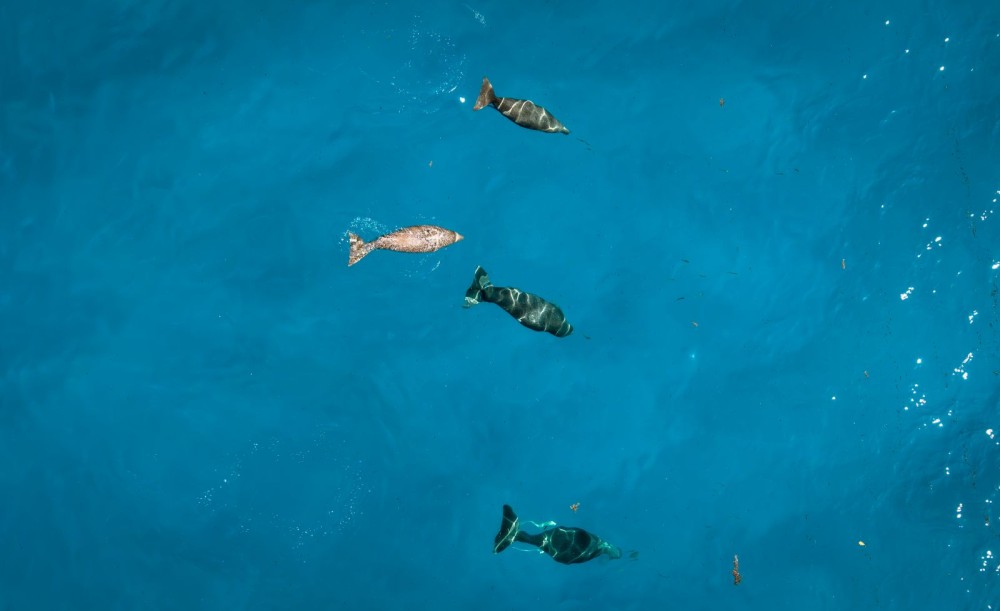
Bazaruto's tides are extreme. The bay drains and fills twice a day in a cycle that can shift the waterline by more than five metres, exposing and then submerging vast seagrass meadows along the mainland and around the islands. To live here, you have to move with the water.
The dugongs do, and they appear to understand these dynamics with extraordinary precision. As the tide rises and the shallow flats flood, the animals push inshore to graze on the seagrass meadows that the water submerges. As it drops and the flats become too shallow, dugongs retreat into the bay's deep channels and feed on deeper seagrass out of site. After dark, they press even closer to shore. And when the moon swings to full or new, driving the strongest tides of the lunar cycle, which reach further inland than usual, the dugongs follow.
Every movement, it turns out, is a response to the land, the water, and the sky above. That connection reflects the ancient knowledge that dugongs have of this seascape and its patterns. It is also, as we discovered, the source of some of their greatest vulnerability.
Outside the Safety Net
 © Mia Stawinski
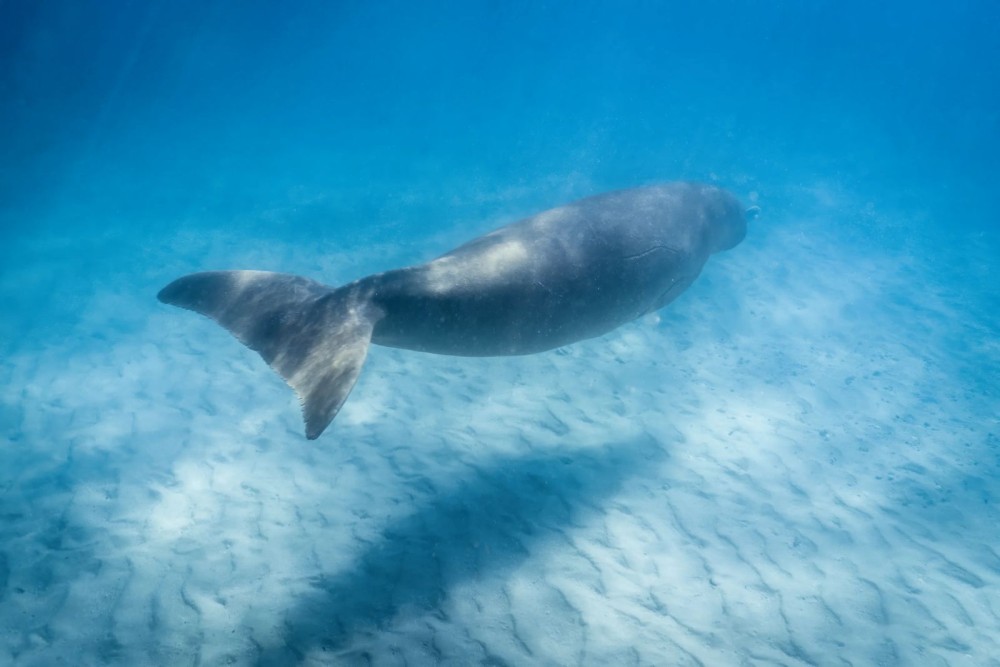
 Most of the dugongs we tagged spent their days in the familiar heart of Bazaruto Bay, moving between the tidal flats, seagrass meadows, and deep channels that make up their world. But BANP doesn’t cover the entire bay, so many of them regularly crossed outside the national park’s boundaries. Outside of this area, BANP rangers can’t actively monitor and enforce restrictions on dangerous fishing methods.
The risks multiply for dugongs not inside BANP. Gill nets, which are large, near-invisible curtains of mesh that hang in the water and trap anything that swims into them, are the single greatest threat to dugongs in the region. Seine nets, which are dragged along the seafloor by fishing crews, pose a different but related danger: they uproot the seagrass meadows that dugongs depend on for food. Inside BANP, both practices are actively regulated. Outside it, enforcement is far harder.
Dugongs are drawn to the shallow, nearshore meadows because that is where the most nutritious seagrass grows. But these are exactly the areas targeted by seine netters, whose nets can destroy large patches of seagrass in a single pass. Fishers from the nearby Inhassoro region have told us that some traditional fishing grounds have lost most of their seagrass cover. If that loss continues, the dugongs' food supply goes with it. Few safe alternatives remain nearby.
A Remarkable Journey South
 © Emma Badger
As striking as the daily rhythms were, it was one longer journey that truly changed how we think about this population.
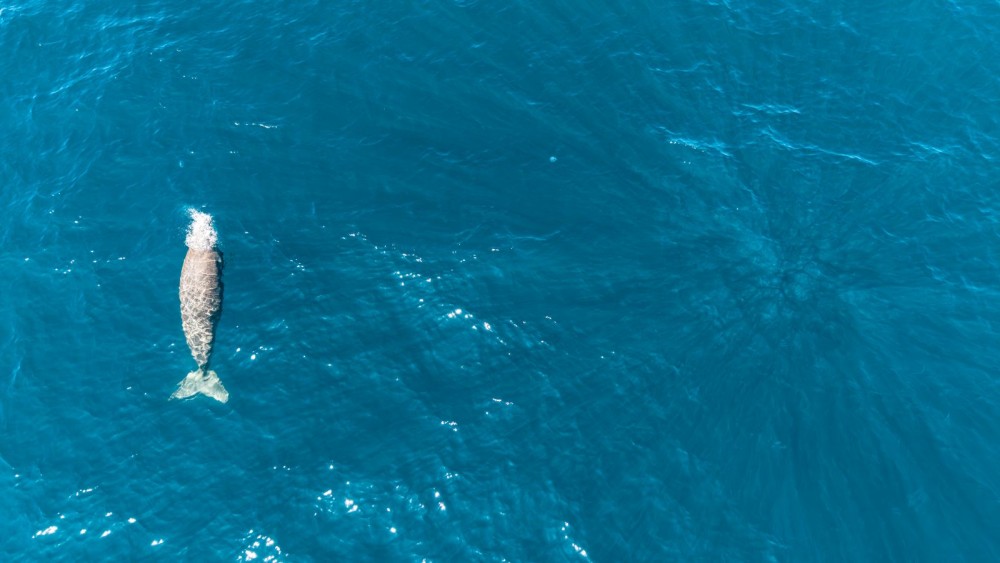
One adult male left Bazaruto Bay entirely, travelling over 200 km south along the dune-swept coast to Inhambane Bay, where he stayed. There, he moved through heavily fished seagrass meadows just offshore from densely populated urban areas, far beyond the protection surrounding Bazaruto. This is the first time a dugong has been tracked making this journey, confirming a connection that we had long suspected but never been able to prove.
It matters enormously. Inhambane Bay has lost much of its seagrass over the past few decades and offers little of the shelter Bazaruto provides. No dugongs were spotted by aerial surveys there 10 years ago, and they are only very rarely spotted by boats. And yet here was one of Bazaruto's own, making the crossing and exposing himself to every risk along the way and upon arrival.
The implication is clear: this population does not live inside a boundary. Protecting East Africa's last dugongs will require conservation efforts across a far larger stretch of coastline than any single national park can cover.
A Bridge to the North
 © Emma Badger
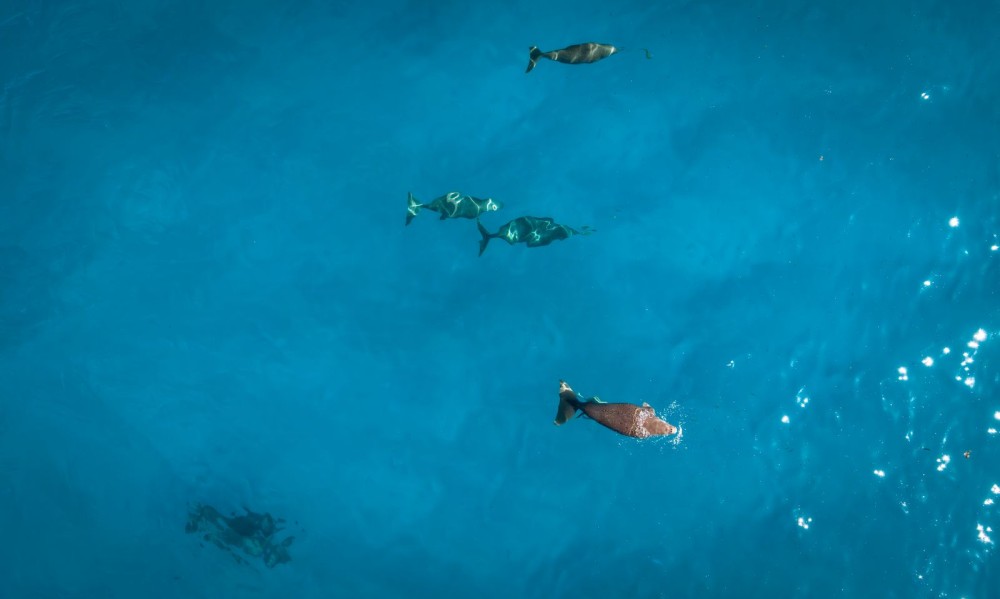
The same lesson came from the other direction. Several young dugongs travelled north into Govuro Bay, which is a large, mangrove-fringed bay near the mouth of the Save River around 100 km north of Bazaruto, where tidal flats stretch between fishing communities that have few alternatives to the sea.
We have known for some time, from aerial surveys, that Govuro is important for dugongs. We have also long suspected that gill netting there is widespread, and that it may be where more dugongs die than anywhere else in the region. What the tags confirmed is that young animals move freely between Bazaruto and Govuro, making the two places part of a single, connected population. A dugong lost in Govuro is a dugong lost from Bazaruto.
Dugongs breed slowly and live long lives. Our modelling suggests that losing even a single adult female each year could be enough to push this subpopulation into long-term decline. If dugongs continue be poached, no level of sustainable fishing isolated to one part can reverse the broader decline.
What This All Means
 © Andy Coetzee
A population navigating a complex seascape with quiet precision. Individuals that cross hundreds of kilometres of open coastline. Young dugongs venturing into bays where the risks are high and the protections are few. Taken together, what these 49 animals have shown us is that their world is larger, more connected, and more fragile than we previously understood.
Keeping them here will take more than a single national park. It will mean working with fishing communities in Govuro and along the coast south of Bazaruto, which have deep ties to the sea and few easy alternatives, to find ways to reduce the use of gill and seine nets in the areas dugongs most depend on. It will mean extending the reach of conservation efforts into areas that have so far received little attention. And it will mean treating the entire coastline, from Govuro to Inhambane, as part of a single conservation challenge.
East Africa's last dugongs are still here. They are telling us, with every tide and every journey, exactly what they need. The question now is whether we can respond in kind.